

It took some of the conference-goers two flights and a layover in Europe just to get there. One flew from his home in Abuja, Nigeria to Paris and then on to Kinshasa, the capital and largest city in the Democratic Republic of the Congo. Another took the Accra to Amsterdam flight, before turning around and flying to Kinshasa.
That’s just how it works when you’re a rabbi in Central Africa, where getting from one place to another isn’t always a straight line.
But make it there they did, all 11 Chabad-Lubavitch emissaries representing 11 Central African countries from Ivory Coast to Tanzania, Ghana to Zambia, for their conference of rabbis in Kinshasa. On Tuesday May 26 they finally met—together for the first time on African soil—celebrating an occasion worth the lengthy journey: 35 years of Chabad of Central Africa.
The occasion was marked on the rooftop of the Sheraton Kinshasa, drawing diplomats, community members, distinguished guests, friends of Chabad, and, somewhere in the middle of it all, colleagues who hadn’t seen each other in years.
Ambassador-at-Large Antoine Ghonda Mangalibi spoke on behalf of President of the DRC Félix Tshisekedi. “Your work goes beyond religious boundaries,” he said. “It touches something more universal: human dignity, respect for others, the transmission of knowledge, and the light of faith.”

Humble Beginnings
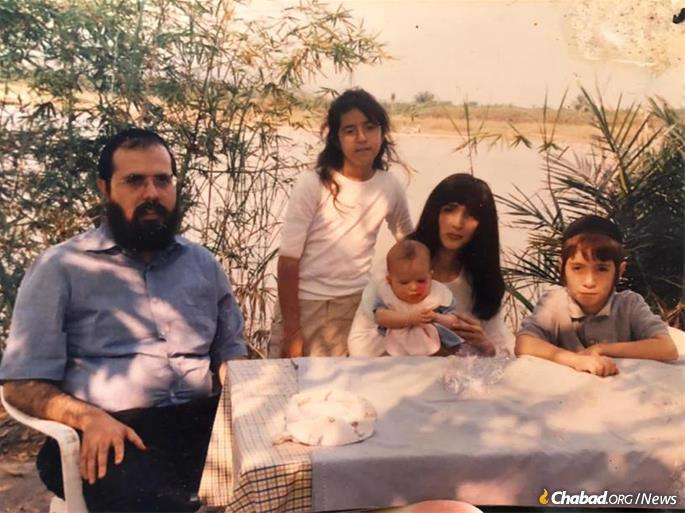
Rabbi Shlomo Bentolila and his late wife, Myriam, received the blessings of the Rebbe—Rabbi Menachem M. Schneerson, of righteous memory—to establish Chabad-Lubavitch of Central Africa on the second-to-last night of Chanukah 1990. They settled in Kinshasa, then Zaire, today Congo, less than a month later.
Life in the Congo wasn’t always easy, especially in the beginning. The Bentolilas headed out to Kinshasa with little fanfare in an age before widespread internet. For a while, they lived in a tiny two-bedroom apartment before moving into a larger and more secure home in the synagogue compound. The country was plagued by electric blackouts, and even once they got a generator, there was no guarantee it wouldn’t blow.
Over time they built a beautiful Jewish community in Kinshasa, Myriam focusing on education and Rabbi Bentolila balancing his responsibilities in the Congo with reaching out to Jews in the rest of Central Africa.
Every holiday season, Bentolila would draft rabbinical students to lead services and organize Passover seders in countries across the continent, in the process discovering Jews in even the remotest parts of Africa. Bentolila would maintain and develop relationships with all the Jews the young rabbis found, and when the need for a full-time rabbi in a location became a necessity, he would dispatch a young couple to build a permanent Chabad center.
Rabbi Israel Uzan was one of those student rabbis. Today he lives in Abuja where he directs, together with his wife Haya, Chabad of Nigeria.
“These years of rabbinical students and Chabad of Central Africa’s outreach allowed the Jews of Nigeria to become familiar with Chabad,” he says. “Because of this foundation, they already knew what to expect from Chabad: the same warm and uplifting atmosphere they tasted during the festivals.”
He and his wife moved to Nigeria in 2011, and were joined by Rabbi Mendy and Mazal Sternbach in neighboring Lagos nine years later.
Rabbi Noach and Alti Majesky first visited Accra, Ghana, during Chanukah of 2014, and returned four months later to lead a community Passover Seder. Seeing how much their presence and service was needed, they stayed.

Today, they lead a community of hundreds of Jews—Israeli expats, American and European businesspeople, and everything in between—guests filling the Chabad center every Shabbat. Their Jewish preschool has dozens of children and hundreds of alumni. They also run a kosher store inside the center, with containers with kosher food and Judaic supplies coming in regularly from Israel.
“The logistics of life are difficult,” Majesky says. “We have to import everything, but it’s worth it. Every year, there are more families joining the community.”
Two years ago, Chabad of Ghana purchased a property. Construction is underway on a permanent facility, a $3 million project that the community is largely funding itself.
What began as a single Chabad House in Kinshasa has, over 35years, grown into eleven permanent Chabad centers across ten countries: the Democratic Republic of the Congo, Nigeria, Angola, Ghana, Ivory Coast, Uganda, Rwanda, Zambia, Kenya, and Tanzania. Each center serves as a full hub of Jewish life, synagogues, Torah classes, educational programs for adults and children, youth activities, kosher facilities, mikvahs, holiday celebrations, lifecycle events, and a welcoming home for residents, businesspeople, diplomats, travelers alike.

Coming Together
The continent’s geography does not always make things convenient.
“People don’t realize that Africa is a continent, and assume all the emissaries here are nearby,” says Majesky. “But it’s hard to see each other in person. At the conference, there were colleagues I met for the first time because travel is so difficult, and there are visas required too.”
But once they were there, something clicked. They all shared common experiences: the same power outages, the same embassy negotiations, the same everyday struggles and successes.
Workshops over the two-and-a-half days covered everything Chabad emissaries deal with: education, youth programming, community development, security, fundraising and outreach approaches specific to the African context.
A highlight of the conference was the announcement of a new Chabad center opening in Senegal, another young couple soon to establish a permanent Jewish presence in a country that has never had one.



Start a Discussion